
Selling Gold Jewelry in Charlottesville: Start by Reading the Stamp
When you sell gold jewelry, almost everything that matters is decided by two things you can check yourself before you ever walk in: the karat stamp hidden on the piece, and its weight. For most rings, chains, and bracelets, the value is melt value — the price of the actual gold inside — not what the piece cost at retail. Once you understand how to read a hallmark and how weighing works, the offer stops being a mystery and starts being simple arithmetic.
Rivanna Precious Metals is a dedicated gold jewelry buyer working by appointment from a private office at 1020 Carrington Place, just off Route 29. We test, weigh, and price every piece in front of you, and we'll tell you honestly when something is worth more than its melt — or worth less than you hoped.
Quick Answer
- Hallmarks decode purity: 375=9K, 417=10K, 585=14K, 750=18K, 916/917=22K.
- Most gold jewelry is paid on melt value (gold weight × purity × spot), not retail price.
- Gemstones and brand names usually aren't paid on a melt purchase — with rare designer/large-stone exceptions.
- Broken vs. wearable makes no difference to melt: a snapped chain pays the same per gram.
- Don't clean or polish first — bring it as-is; we pay cash or check, same day.
How Do I Read the Hallmarks and Karat Stamps?
Pick up almost any piece of gold jewelry and look at the clasp, the inside of the band, or the back of a pendant. You'll usually find a tiny stamp — the hallmark — that tells you the purity. There are two common systems:
- U.S. karat stamps: "10K," "14K," "18K," "22K," sometimes written "417," etc.
- European parts-per-thousand stamps: a three-digit number showing how much gold is in 1,000 parts. 375 = 9K, 417 = 10K, 585 = 14K, 750 = 18K, 916 or 917 = 22K, 999 = 24K.
Be careful with letter stamps. GF (gold-filled), GP (gold-plated), GE (gold electroplate), RGP (rolled gold plate), and HGE all mean there's only a thin layer of gold over a base metal — these are not solid gold and are worth a small fraction of a stamped 14K or 18K piece. A "925" stamp means sterling silver, not gold. If a piece has no stamp at all, don't worry: plenty of older, handmade, and imported gold was never marked, and we confirm purity by testing.
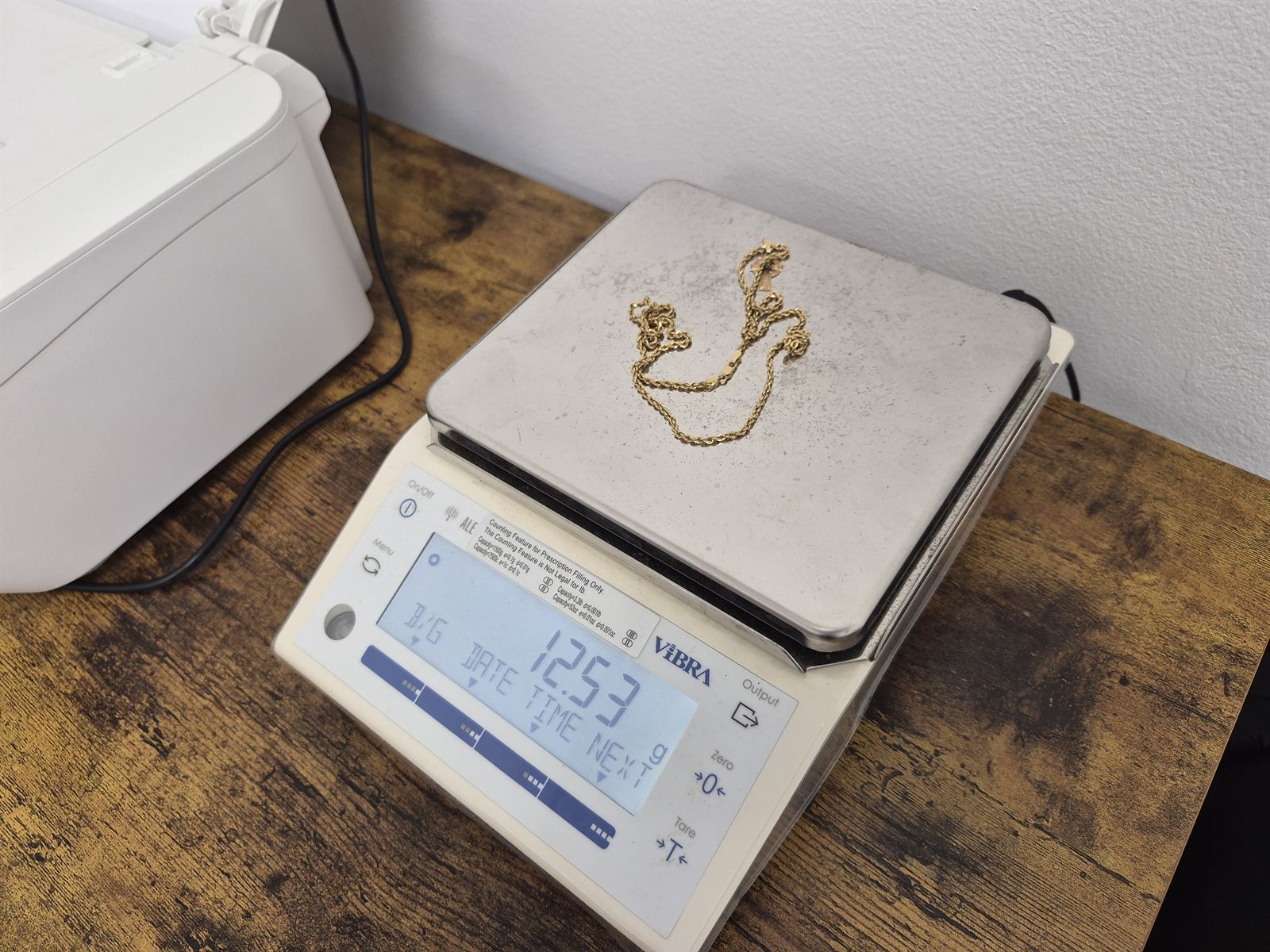
How Does Weighing Work, and What Is My Jewelry Worth Per Gram?
Every piece goes on a calibrated digital scale and is measured in grams (some dealers use pennyweight, where 1 dwt ≈ 1.555 g). The key detail most people miss: we weigh different karats separately. Tossing a 10K class ring and an 18K bracelet on the scale together and paying one rate would shortchange the 18K, so we sort first.
From the weight, the math is the same one used across the gold trade: gram weight × purity percentage × the live per-gram spot price. A 7.5-gram 14K chain is 58.3% gold, or about 4.37 grams of pure gold, and your offer is a share of that content's market value. Because we price off live spot and explain each number out loud, you can follow the whole calculation. If you'd like the deeper breakdown of karat percentages and how spot price is converted to a per-gram figure, our main Charlottesville gold dealer guide walks through it step by step.
Why Aren't Gemstones and Brand Names Usually Paid on Melt?
This is the question that surprises people most. On a standard melt purchase, the diamonds, sapphires, and other stones in a piece are generally not paid as part of the value, and their weight is deducted from the gold. It isn't a trick — the wholesale resale market for small, commercial-grade stones pulled from old jewelry is thin, slow, and unpredictable, so they simply don't carry reliable cash value the way gold does.
There's a real exception, though, and we look for it on every piece. A sizable, high-quality diamond, or a piece from a sought-after designer house — think recognizable signed work — can be worth considerably more as a complete, wearable item than as scrap gold. When we spot one, we tell you, and we'll price the piece on its full collector or resale value instead of melting it. If you have something that might fall in that category, our jewelry buyer page explains how we weigh melt value against resale value.
Does It Matter If My Gold Jewelry Is Broken?
For melt, not at all. A snapped rope chain, a ring crushed in a drawer, a single earring whose match vanished years ago — each still contains exactly the grams of gold it always did, and that's what sets the price. We buy broken and wearable gold at the same per-gram rate. Don't throw out a kinked chain or an orphan stud thinking it's worthless; bring it in.
The only time condition changes the math is when a piece has genuine value as jewelry — an intact designer bracelet, for instance — where being whole and undamaged matters to a future wearer. For ordinary gold, melt is melt, and we'd rather you not spend a minute repairing anything before you sell.
What Kinds of Gold Jewelry Do We Buy?
- Rings — wedding bands, engagement rings, men's rings, class rings, cocktail and signet rings, inherited rings
- Necklaces & chains — rope, Figaro, Cuban link, herringbone, box, solid and hollow gold
- Bracelets — bangles, link, tennis, and charm bracelets
- Earrings — hoops, studs, drops, huggies, and single orphan earrings
- Gold watches — solid gold cases and bracelets with real precious-metal content
- Pendants, charms, lockets, and brooches — the pieces that live in the back of a jewelry box
We buy 10K, 14K, 18K, 22K, and 24K gold jewelry, marked or unmarked, and we test anything in question right in front of you.
What Should I Bring to a Charlottesville Appointment?
- The gold jewelry you're considering selling — tangles, knots, and missing stones are fine
- A government-issued photo ID (required under Virginia law for these transactions)
- Any original certificates or receipts for higher-end designer or diamond pieces (optional, but helpful for resale-value items)
That's it. There's no need to clean or polish — in fact, please don't, since polishing can shave off a trace of gold. Whatever your reason for selling, from settling an estate to simply clearing a drawer, the appointment is private and unhurried, and you're never obligated to explain anything or to accept an offer.
Ready to Sell Gold Jewelry in Charlottesville?
Book a private, no-obligation evaluation. Most appointments available within 30 minutes.