
A Calm Guide for Executors and Heirs Handling an Estate
If you're an executor or heir, you've probably been handed a jumble of jewelry, coins, and silver with no idea what's valuable and what's junk — and a quiet worry about being taken advantage of while you're already grieving. This page is written for you. We buy the gold, silver, coin, and bullion portion of estates in Charlottesville and across Central Virginia, sorting the real from the costume in front of you and paying fair, spot-based prices in a single private appointment.
We are not a general estate sale company. We don't hold sales in the home, haul furniture, or price artwork and antiques. What we do well is identify, test, and buy everything precious-metal so the family can turn that portion into cash transparently. Below we'll teach you how to recognize real gold and silver, how sterling differs from silverplate, what to do with inherited coins, and how we keep the whole thing fair when several heirs are involved.
Quick Answer
- We evaluate the whole lot at once, sorting real gold and silver from costume and plate in front of you.
- Real gold is karat-stamped (10K, 14K, 585, 750); sterling is marked .925, while silverplate (EP, EPNS) has little melt value.
- Inherited coins are reviewed individually — bullion at spot, scarce dates at collector value — never as one melt pile.
- Everything is itemized and transparent, so the figures hold up across multiple heirs and estate attorneys.
- We buy precious metals only — not furniture, art, or full cleanouts — and there's no obligation to sell.
How does a whole-lot estate evaluation work?
The key word for estates is "whole-lot." You don't need to know what anything is before you arrive — in fact, we'd prefer you didn't guess. Bring it all exactly as it came: boxes, bags, envelopes, coin folders, the velvet roll, the rattling drawer. At the appointment we spread everything out and sort it into clear categories in front of you: solid gold, sterling silver, bullion, collectible coins, scrap, and the costume-or-plate pile that has no metal value.
From there, every genuine piece is tested for purity with acid or an XRF analyzer and weighed on a certified scale, and coins are reviewed one at a time. You receive an itemized offer based on current spot prices and any collector value. Nothing gets lumped together, and nothing goes into a back room. If you'd like to understand how the metal markets behind those prices move, our precious metals dealer page explains the live spot market in plain terms.
How can you tell real gold from costume jewelry?
This is the question that stops most families cold, because an estate box usually mixes a few genuine pieces in with a lot of fashion jewelry. A few reliable signals help: real gold carries a karat stamp — 10K, 14K, 18K, or the European equivalents 417, 585, 750 — and it never tarnishes or turns skin green. Costume jewelry is often unmarked, or stamped with tells like "gold tone," "GP" (gold plated), "GF" (gold filled), or "HGE," and the base metal shows through where it's worn.
Those clues narrow things down, but only a test is certain — plenty of solid gold is unmarked, and plenty of convincing fakes are stamped to look real. That's exactly why we say bring everything, including the pieces you're sure are worthless. We test each one and tell you honestly what it is. To see how individual jewelry pieces are valued once they're confirmed genuine, our jewelry appraiser page walks through the process.
Is the flatware sterling silver or silverplate?
Inherited silverware is one of the most misjudged parts of an estate — in both directions. People throw away valuable sterling thinking it's "just silverware," and others expect a fortune from a plated set. The difference is enormous, so here's how to read it:
| Sterling silver | Silverplate | |
|---|---|---|
| Composition | 92.5% solid silver throughout | Thin silver layer over base metal |
| Common marks | "Sterling," ".925," "925" | "EP," "EPNS," "Silverplate," "A1," maker name only |
| Melt value | Significant — priced on silver weight | Little to none |
Sterling trays, tea services, and full flatware sets often hold substantial value and are routinely overlooked, while silverplate — however pretty — is essentially decorative for our purposes. We check the marks, test where there's any doubt, and tell you plainly which pieces are which. Sterling is paid on weight against the current silver spot price, the same way described on our silver bullion page.
What should an executor do with an inherited coin collection?
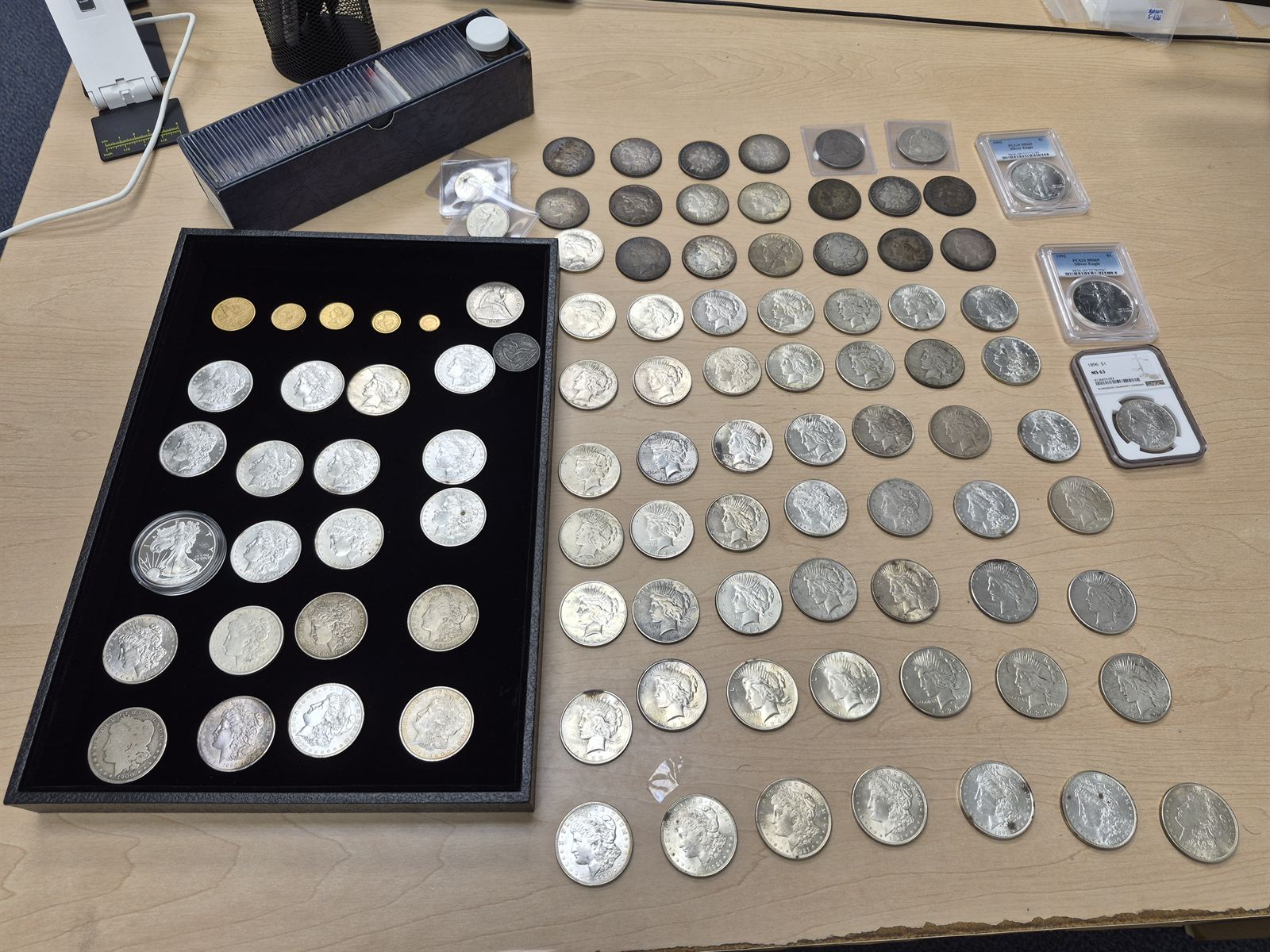
Three rules save families the most money. First, don't clean the coins — cleaning can permanently lower the value of anything collectible. Second, don't sort by guesswork or sell as one melt lot, because a single key-date coin paid as melt is money gone for good. Third, bring the whole collection — albums, rolls, loose coins, proof sets, and slabs — for an individual review.
We go through it piece by piece: bullion coins at spot, pre-1965 junk silver on its silver content, and scarce dates or high grades valued as numismatic pieces. A 40-year collection that nobody in the family understands becomes a clear, documented list of what each coin actually is. That distinction between melt and collector value is the heart of what a dedicated coin dealer brings to an estate.
How do you keep an estate evaluation fair across multiple heirs?
When several siblings or relatives share an estate, fairness has to be visible, not just promised. Everything we do is itemized and out in the open: you watch each test, see the weight on the scale, and hear the value explained for every category. The result is a clear, item-by-item breakdown you can share among the family or hand to an estate attorney.
Because there's no obligation to sell, heirs can take that documented valuation, discuss it privately, and decide together before anything changes hands. Whether the family wants to divide the value, sell some categories and keep others, or convert the whole precious-metal portion to cash, the transparent numbers mean no one is left wondering whether the deal was square.
What we buy from estates — and what we don't
Bring anything that might contain gold or silver; we'll sort and test it on-site.
- Gold jewelry of any karat — rings, chains, bracelets, brooches, lockets, gold-cased watches
- Silver jewelry — sterling (.925), coin silver, and hallmarked pieces
- Gold and silver coins — Eagles, Morgan and Peace dollars, pre-1933 U.S. gold, Mercury dimes, Walking Liberty halves, foreign and slabbed coins
- Entire coin collections — Whitman folders, bank rolls, proof sets, uncirculated rolls
- Gold and silver bullion — bars, rounds, wafers, stamped ingots
- Scrap and dental gold — broken chains, single earrings, gold teeth, bent rings
- Sterling flatware & hollowware — tea services, trays, pitchers, utensil sets, bowls
Because we specialize, there's a clear line around what we handle. We do not buy furniture or furnishings, artwork (unless significantly composed of precious metal), antiques or china, vehicles or tools, household goods, standalone gemstones, or full "clean out the house" services. For those, we're glad to refer you to trusted local estate sale professionals — and we frequently act as their precious-metals partner so families get refinery-level rates on the gold and silver instead of storefront retail.
How an estate appointment runs
1. Schedule privately
Call or text 434-995-0404 or book on the home-page calendar. Tell us roughly what you're bringing so we can set aside enough time; for large estates we block a longer window.
2. Bring it all as-is
Boxes, envelopes, folders, display cases — whatever it's stored in, including items you're unsure about. We'd rather sort through extra than miss something of value, and please don't clean or polish anything first.
3. Private, on-site evaluation
At 1020 Carrington Place we meet one-on-one. Every piece is tested, weighed, and categorized in front of you, and coins are reviewed individually. You see every test, weight, and price.
4. Itemized offer
We present an offer based on current spot and collector values. If something isn't worth buying — costume, plate, or otherwise — we'll say so and explain why. The evaluation is always free.
5. Same-day payment, or take it home
Accept and you're paid cash or check on the spot. Prefer to think it over? You leave with everything and zero pressure to return.
Serving Charlottesville & Central Virginia
Families from across Central Virginia bring estate jewelry and coin collections to our Charlottesville office:
- Albemarle County — Crozet, Ivy, Keswick, Earlysville, Free Union, North Garden, Scottsville
- Greene, Madison, Fluvanna, Louisa, Nelson, and Orange counties
- Ruckersville, Gordonsville, Waynesboro, Staunton, Harrisonburg
- The Route 29 and I-64 corridors across Central Virginia
Ready to Evaluate an Estate's Precious Metals?
Private, respectful, and appointment-only. We understand estates involve grief as much as paperwork — we handle both with care.