
What a Coin Dealer Really Does With Your Collection
A good coin dealer doesn't just buy coins — we tell you which of your coins are worth more than the metal they're made of, and which aren't. When you bring a collection into our Charlottesville office, the work is the sorting: separating bullion from collectible (numismatic) pieces, pulling the pre-1965 silver out of the loose change, checking dates and mintmarks against the keys that actually carry a premium, and pricing each coin on its own merits.
Most collections are a blend. A cigar box that looks like "old change" might hold a tube of 90% silver quarters, a few common Morgans, and one genuinely scarce key date hiding in plain sight. Our job at 1020 Carrington Place is to find all three and pay you correctly for each — the silver at its content value, the common coins at fair retail, and the sleeper at what it's truly worth.
Quick Answer
- Pre-1965 U.S. dimes, quarters, and half dollars are 90% silver ("junk silver") and worth many times their face value.
- Common Morgan and Peace dollars trade on silver content; scarce dates and high grades can be worth far more.
- A coin beats melt because of its date, mintmark, rarity, or condition — never because it's simply "old."
- Never clean a coin: cleaning almost always lowers what a collector will pay.
- We evaluate every coin individually, show the math, and pay cash or check the same day.
What kinds of coins does a Charlottesville coin dealer buy?
We buy the full range — from a single American Eagle to an inherited collection that fills a drawer. In practice, the coins that come across the desk fall into a handful of recognizable families:
- Gold bullion coins — American Gold Eagles and Buffalos, Canadian Maple Leafs, South African Krugerrands, Austrian Philharmonics, Chinese Pandas, and Mexican Libertads
- Pre-1933 U.S. gold — $20 Double Eagles (Saint-Gaudens & Liberty), $10 Indian Head and Liberty, $5 and $2.50 pieces, many of which carry a collector premium above their gold
- Silver bullion coins — American Silver Eagles, Canadian Maple Leafs, Austrian Philharmonics, and generic rounds
- Pre-1965 U.S. 90% silver — Morgan and Peace dollars, Walking Liberty and Franklin halves, the 1964 Kennedy, Washington quarters, and Mercury and Roosevelt dimes
- 40% silver — 1965–1970 Kennedy halves and the 1976 Bicentennial issues
- World coinage — British sovereigns, Swiss and French 20 Francs, and older foreign silver
- Whole collections — Dansco and Whitman albums, 2x2 flips, proof sets, and loose accumulations
What is "junk silver" and why is it worth more than face value?
"Junk silver" is one of the most useful terms in coin buying, and one of the most misunderstood. It refers to ordinary, circulated U.S. coins struck in 1964 or earlier, back when dimes, quarters, and half dollars were made of 90% silver. The word "junk" only means there's no collector premium — it says nothing about the value. These coins are worth many times their face value purely for the silver in them.
Here's the practical rule of thumb: $1.00 in face value of pre-1965 dimes, quarters, or halves contains roughly 0.715 troy ounces of pure silver. So a single silver quarter holds far more silver value than its 25-cent face, and a coffee can of old change can quietly be worth thousands. We price junk silver off the live silver spot price and the actual silver weight — no guesswork, and you see the calculation. If you're weighing a larger stack of bars and rounds against your coin silver, our guide to selling silver bullion in Charlottesville breaks down how those premiums compare.
Are Morgan and Peace silver dollars worth more than their silver?
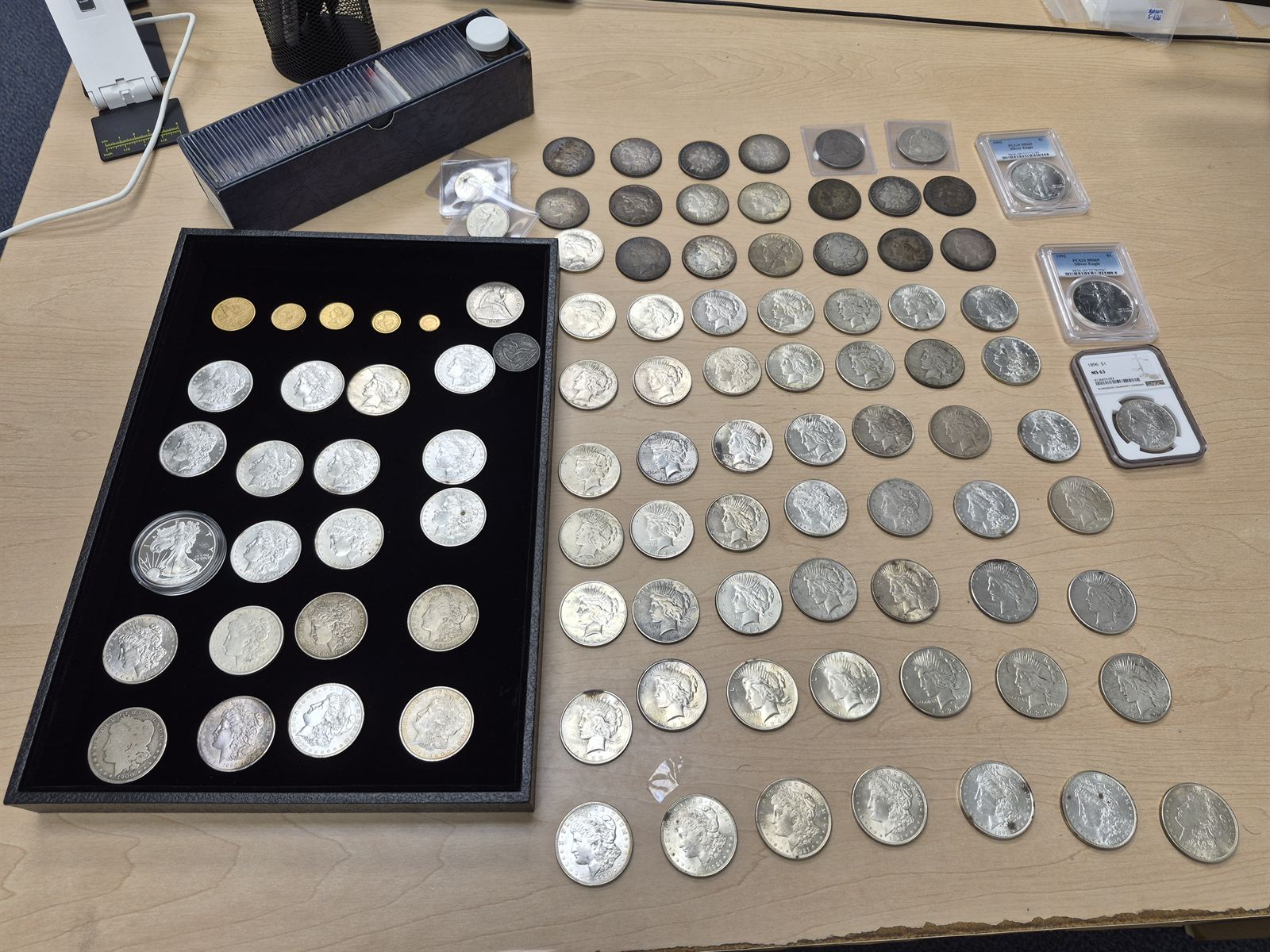
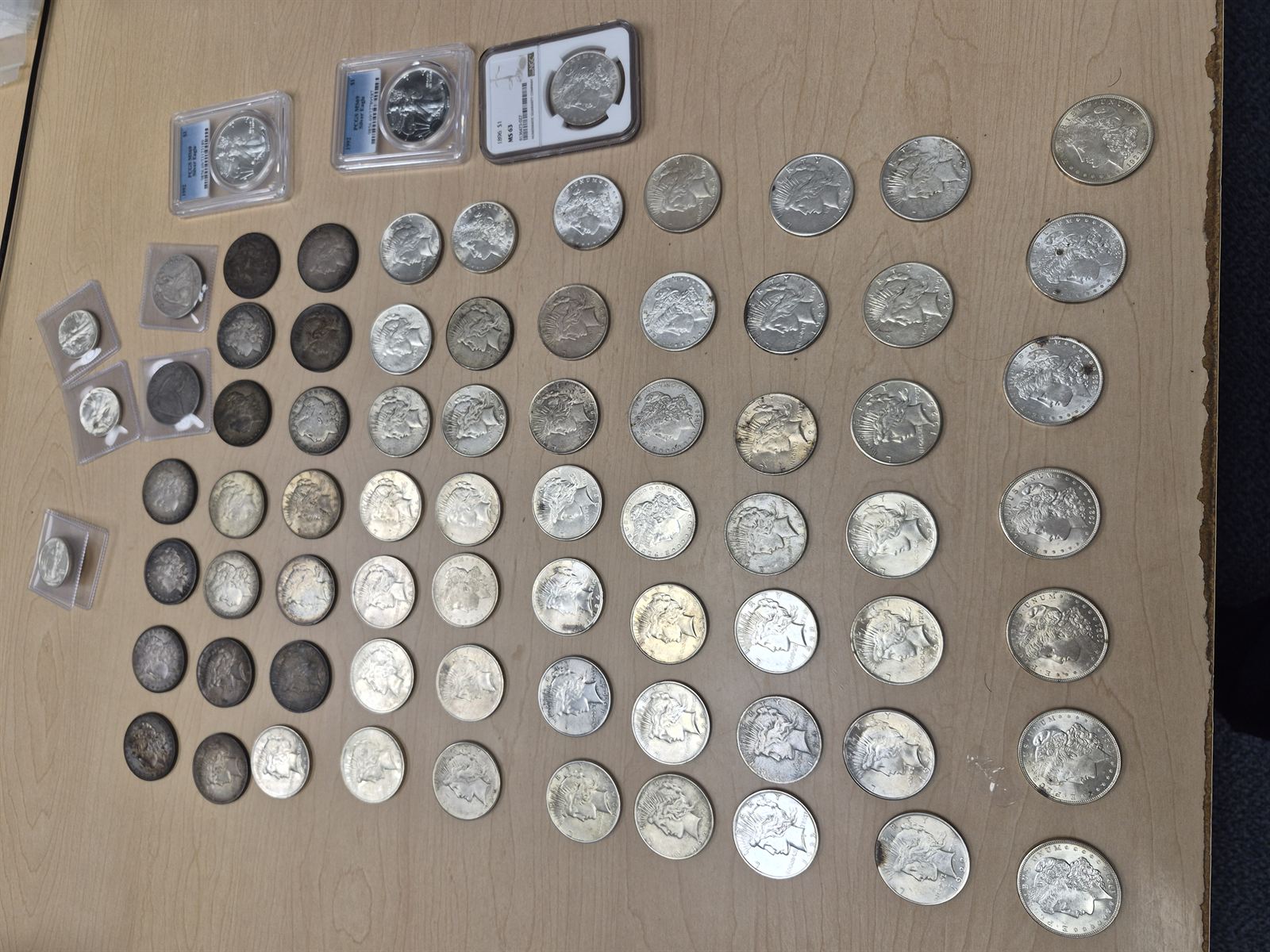
Silver dollars are the coin we're asked about most. Morgan dollars (1878–1904, with a final run in 1921) and Peace dollars (1921–1935) each contain about 0.7734 troy ounces of silver, so even the most common, well-worn example is worth comfortably more than a dollar. For circulated common dates, the silver content is the floor — that's what makes them valuable to nearly everyone.
Above that floor, certain dollars climb fast. Carson City issues (the famous "CC" mintmark), low-mintage dates, and uncirculated coins with original mint luster can be worth several times their silver. That's exactly why we never run a bag of dollars across the scale as one melt lot. Each one gets looked at for date, mintmark, and grade first, and anything that deserves a premium is set aside and priced as a collectible rather than as bullion.
What makes a coin worth more than its melt value?
Four things lift a coin above its metal content: date, mintmark, rarity, and condition. A low-mintage year, a scarce mint of origin, a die error, or an exceptional state of preservation can each add a premium — sometimes a small one, sometimes a life-changing one. The catch is that none of this is about age. A worn 1880s coin can be common as dirt, while a coin from your lifetime can be a key date.
This is the single most expensive mistake we see people make: assuming "old" equals "valuable," or the reverse, assuming nothing modern matters. We check the specifics. If your coin's value lives in its metal, we price it on metal. If it lives in its rarity, we price it on rarity — and we explain which one we're looking at and why.
How does coin grading work, and do I need my coins graded?
Coin grading is a standardized way of describing condition on the 70-point Sheldon scale, from a barely identifiable "Good" up to a flawless "MS-70." Services like PCGS and NGC seal graded coins in tamper-evident "slabs" with their assigned grade. Grade matters enormously for collectible coins, because the jump from one grade to the next can multiply the price.
That said, most people do not need to grade their coins before selling. Certification costs money and takes weeks, and it only makes sense on coins valuable enough to justify it. We can evaluate raw (un-slabbed) coins accurately right at the desk. If you happen to own something where professional grading would genuinely pay off, we'll say so honestly instead of buying it under value. For a quiet, unrushed look at a special piece, our private appraisal service is built exactly for that conversation.
Do U.S. and foreign coins get valued differently?
Less than people expect. A coin dealer values world gold and silver on the same logic as domestic coins: bullion issues trade on their metal content, and scarcer pieces trade on their collector value. A British sovereign or a Swiss 20 Franc is essentially fractional gold with a familiar, trusted weight, so it prices off gold spot. Older foreign silver prices off silver spot the same way junk silver does.
Where origin can matter is liquidity and recognition — widely traded coins like Maple Leafs, Krugerrands, and sovereigns are easy to value and move, while obscure world coins take more research. Either way, we identify what you have rather than lumping unfamiliar coins into a melt pile. If your collection leans toward gold, you may also want our focused breakdown of selling gold coins in Charlottesville.
Should I clean my coins before selling them?
Please don't. Cleaning is one of the very few things that can permanently reduce a coin's value, and it's the honest limitation we most want people to hear before they walk in. Polishes, dips, jewelry cloths, and abrasives leave fine hairline scratches and an unnatural brightness that collectors and grading services immediately recognize and penalize. A coin that might have earned a premium in original condition can be knocked down to melt value by a few minutes of well-meaning scrubbing.
Natural toning — the soft gray, gold, or rainbow color coins develop over decades — is desirable, not a flaw. Bring your coins exactly as you found them, tarnish and all. If something needs attention, that's a decision for a professional after evaluation, never something to do at the kitchen sink beforehand.
Why work with a local Charlottesville coin dealer?
Mail-in coin buyers look convenient until you realize you've lost control of your collection the moment it leaves your hands. Pawn shops in the area generally aren't coin specialists, so genuine key dates get bundled in with common bullion and paid as melt. A dedicated local dealer sits in the middle: the expertise to recognize what your coins actually are, with the live-market pricing and same-day payment that keep the deal fair and fast.
Everything happens in front of you. You watch the sorting, see the spot price, and follow the math — weight, purity, and premium — on every coin worth buying. You decide whether to sell or walk out with everything you came in with. If you're settling a loved one's estate rather than thinning your own collection, our estate jewelry and coin buying page explains how we handle whole inherited lots fairly across multiple heirs.
Where our Charlottesville coin customers come from
Collectors and families regularly drive into our office from across Central Virginia:
- All of Albemarle County — Crozet, Ivy, Earlysville, Keswick, Free Union, North Garden
- Greene County, Madison County, Fluvanna County, Louisa County, Nelson County, Orange County
- Waynesboro, Staunton, and the greater Shenandoah Valley
- Ruckersville and the Route 29 corridor
Have Coins You're Ready to Sell?
Book a private, no-obligation evaluation with Charlottesville's dedicated coin dealer.